
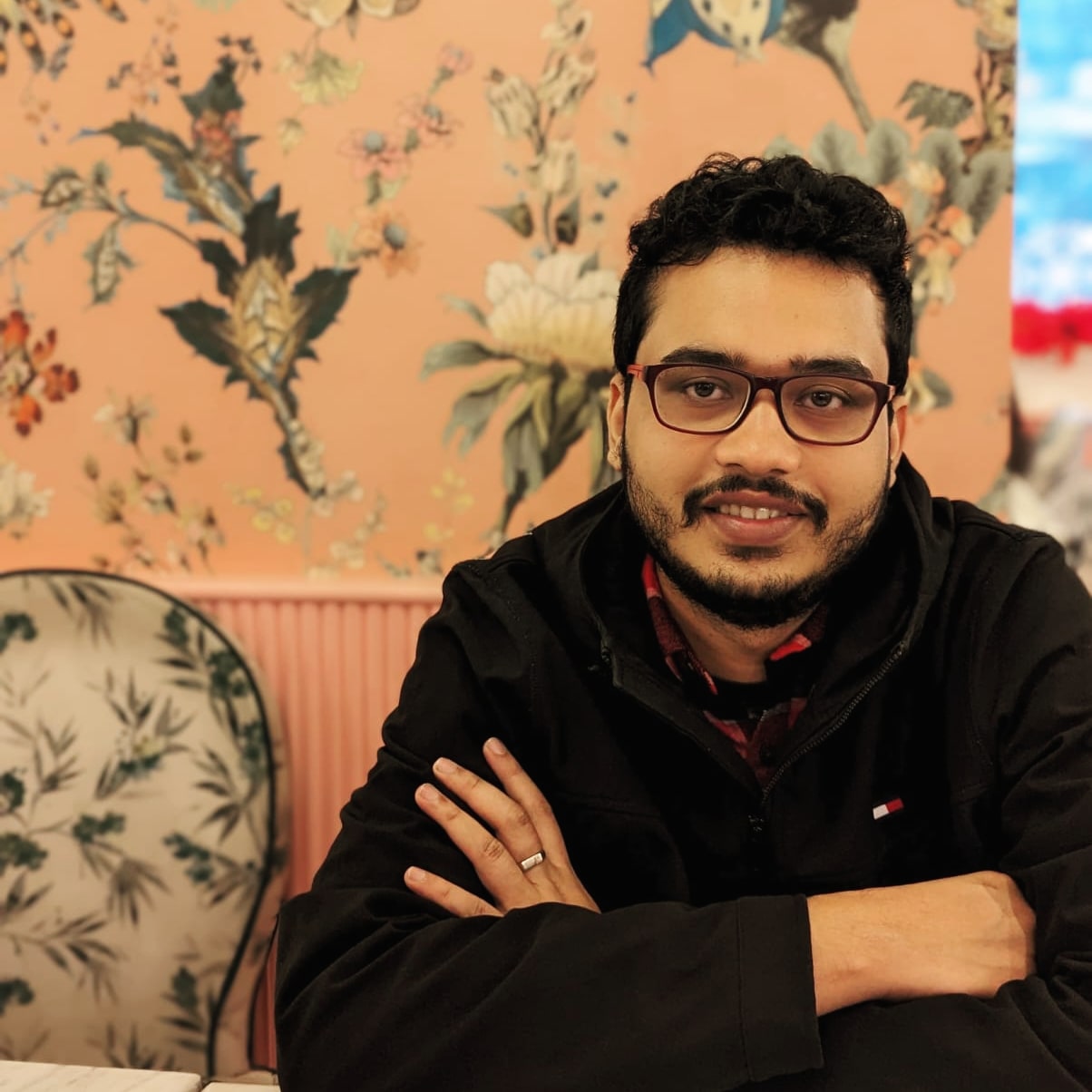
My name is Suvendu Ghatak. I am a PhD candidate in English at the University of Florida. In my dissertation research, I explore the conjunctures of medical and cultural narratives in obscuring the impact of colonial developmentalist policies on malarial epidemics, and in marking the disease as a malady of primitivity and degeneracy. I trace the continuities of this colonial semantics of malaria in postcolonial state policies and medical practices in South Asia. My archival research for the dissertation has been funded by the American Institute of Indian Studies, and the Center for the Humanities and the Public Sphere, UF. More broadly, he is interested in how prolonged crises, beyond the suddenness of “outbreak” or the closure of cure, shape disease imaginaries and medical practices in the Global South.
I grew up in rural West Bengal in India, I had numerous occasions to attend the traditional theatre, called “jatra”, during the Manasa (the Hindu Goddess of snakes, especially worshipped in Eastern India) Puja celebrations during the Monsoon, as well as in the form of traditional oral recitals called “panchali path”, especially in the Spring, when Sitalamangala (literally Benediction of the Goddess Sitala) would be recited. These were my first encounters with disease narratives without knowing so. In my undergraduate and graduate education in India, we largely read the Western canon, but the training I received taught me to think of literature alongside history. I have always been interested in the long nineteenth century, its lingering proximity that continues to shape our present as well as distance. However, I did not really think that I will be interested in researching the history of diseases in the nineteenth century. The philosophy of Water Benjamin, or the poetry of Ted Hughes and Seamus Heaney seemed more interesting—although, imperceptibly, these inculcated in me an interest in temporality, which continues to shape my thinking. In my graduate studies in the US, I was especially stuck by the way diseases are often presented through the lens of the gothic, the thriller, or the noir, that seems to have a significant contrast with the kind of disease narratives I knew as a child. This unevenness of disease narratives alerted me to the role of genres in configuring specific political horizons, a question that fundamentally spurs my dissertation research.